Quick Answer: How can you legally get out of payday loans in Texas?
You can legally get out of payday loans in Texas by stopping the borrowing cycle, reviewing your loan documents, checking the lender or Credit Access Business information, addressing automatic bank debits properly, asking for a written payment arrangement, disputing improper collection conduct when needed, and considering bankruptcy if payday loans are part of a larger debt problem.
Before taking action, review:
Who the lender or Credit Access Business is
How much you borrowed and how much you are expected to repay
Whether the loan includes ACH or debit card authorization
When the next automatic payment is scheduled
Whether the loan has already gone to collections
Whether the collector is making illegal threats
Whether the loan is connected to a title loan or vehicle risk
Whether you also have credit card debt, medical bills, lawsuits or bank account problems
Whether Chapter 7 or Chapter 13 bankruptcy could help stop collection activity
Important note: Stopping an automatic debit does not erase the payday loan debt. It may protect your bank account from repeated withdrawals, but you may still need a legal strategy for handling the balance.
Payday loans in Texas
A payday loan usually starts with one urgent bill. A car repair. A utility shutoff notice. Groceries before the next paycheck. The money arrives fast, and for a few days, the pressure drops. Then the next payday comes, the lender pulls from the bank account, fees hit, the rent is still due, and the borrower takes another loan to cover the first one.
That is the cycle many Texans are trying to escape. Legally getting out of payday loans in Texas usually means doing several things in the right order: stop borrowing, read the loan documents, understand who is collecting and under what authority, address automatic bank debits carefully, ask for a payment arrangement or dispute the debt when appropriate, and consider bankruptcy if payday loans are only one part of a larger debt problem.
This article is general information, not legal advice. Payday loan contracts can differ, and Texas rules may depend on the lender, the city, the loan structure, and whether the debt has already gone to collection.
What makes payday loans in Texas so hard to escape?
A payday loan is built around speed. The borrower needs cash fast, the lender offers a short-term loan, and repayment is often tied to the next payday. That structure is what creates the trap.
A person may borrow $400 for an emergency expense, expecting to repay it from the next paycheck. But the next paycheck already has rent, food, gas, insurance, utilities, and maybe another debt payment attached to it. When the payday loan comes due, paying it in full can leave the borrower short again. The next move is often another loan, a rollover, refinancing, or a new cash advance from a different lender.
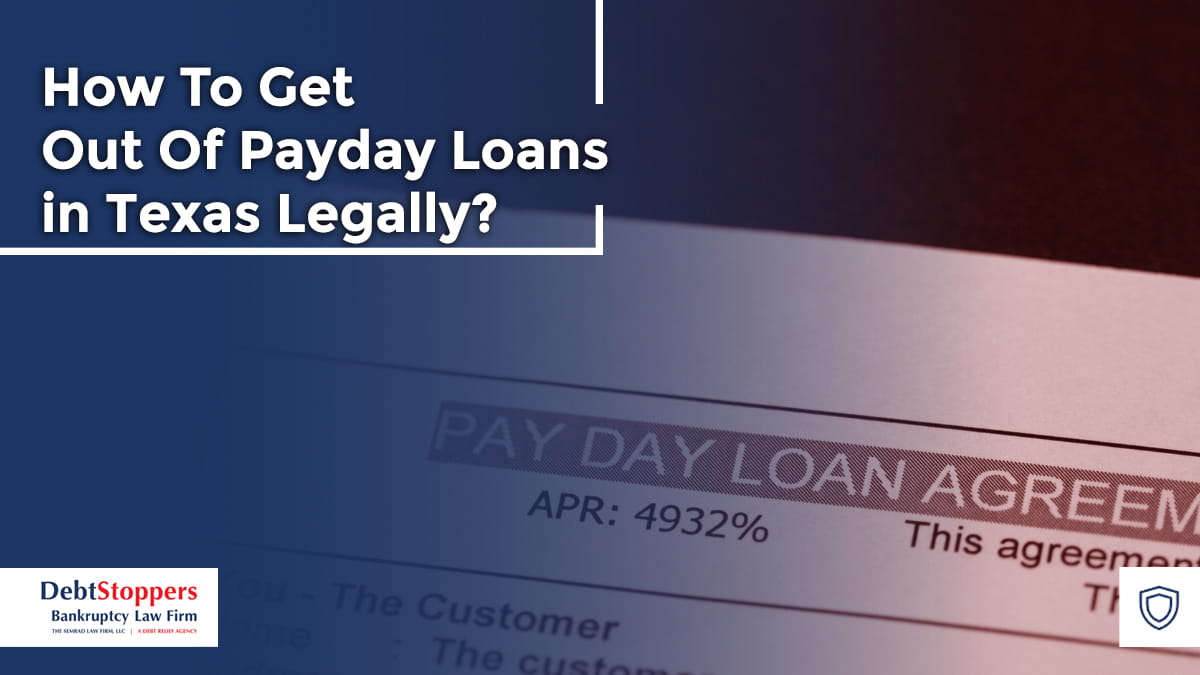
The annual percentage rate can look shocking because payday loans are short-term. Texas regulators’ own consumer disclosure form lists payday loans as the most expensive category in its comparison, showing an average APR of 415% and average fees and interest of $34.14 per $100 borrowed over one month.
The real damage is not only the APR. It is the timing. A debt that comes due all at once, right when the borrower needs the paycheck for basic living costs, can turn one emergency into a recurring debt problem.
How Online Payday Loans in Texas Work and What Borrowers Should Watch For?
Many borrowers do not walk into a storefront anymore. They search for online payday loans in Texas, fill out a form, upload basic information, and wait for approval. Some sites are direct lenders. Others are lead generators or platforms that forward the application to another lender or an unaffiliated third-party lender.
The online process may ask for personal information, income, employment details, identification, a bank account, debit card information, and direct deposit details. Requirements vary by lender, and approval is usually subject to verification.
Online loans can feel more private than going into a store. They can also move quickly. Funds may arrive by direct deposit, sometimes by the next business day, and some lenders advertise same-day funding or instant funding. Speed, however, is not the same as affordability.
Before accepting funds, the borrower should slow down long enough to check the repayment amount, the due date, the APR, the lender or CAB name, the authorization for electronic debits, and whether the agreement allows refinancing or renewals. The most dangerous payday loan is often the one that feels easiest to get.
Texas Payday Loans, Credit Access Businesses, and State Regulations
With Texas payday loans, the paperwork may show more than one party. In Texas, many payday and title loan businesses operate through the Credit Access Business model. A CAB may help the consumer obtain credit from an independent third-party lender and then charge a fee for arranging that credit. OCCC explains that the CAB is the licensed business in this regulated industry, while the actual third-party lender is not licensed under that same CAB framework.
That distinction matters because borrowers sometimes think they are dealing with one simple lender when the transaction may include both a promissory note with a lender and a separate credit service agreement with the CAB.
Texas Finance Code also treats deferred presentment transactions as payday loans and separately defines motor vehicle title loans as loans secured by an unencumbered vehicle.
Some Texas cities add their own rules. For example, Fort Worth and Houston have ordinances that limit certain payday loan amounts to 20% of the borrower’s gross monthly income and restrict renewals or refinancing in specific ways. Those rules are local, not a blanket statewide rule for every borrower in Texas.
Payday Loans Texas Borrowers Should Separate from Installment Loans and Personal Loans
Many borrowers search for payday loans in Texas because they need quick money and have bad credit or credit difficulties. The problem is that search results may mix several products together: traditional payday loans, online installment loans, personal loans, cash advance apps, and title loans.
They are not the same. A payday loan is usually due in a short period, often on the next paycheck. CFPB describes payday loans as short-term, high-cost loans, commonly for $500 or less, generally due on the next payday.
An installment loan is repaid through scheduled payments over time. That does not automatically make it safe. Online installment loans can still carry high fees, high interest, and aggressive payment terms, but the payment structure is different from a single-payment payday loan.
A personal loan may come from a bank, credit union, online lender, or finance company. It may involve a credit check, may report to credit bureaus, and may offer lower rates for borrowers with stronger credit histories. For someone with bad credit, the cost can still be high, but it is worth comparing the total cost before signing another short-term loan. The key question is not only whether you qualify. The better question is whether the payment leaves enough money to live on after it clears.
Payday Loans Online Texas: Why Instant Approval and Day Funding Can Be Misleading?
Marketing phrases do a lot of work in this industry. A borrower who sees payday loans online in Texas may also see promises about fast approval, easy forms, day funding, instant funding, or money by the next business day.
Those phrases need careful reading. The phrase online payday loans Texas instant approval does not mean guaranteed approval. It does mean no verification. It does mean no credit risk. It does not mean the funds will arrive immediately. Approval may still depend on income, bank account status, identity verification, lender policies, cutoff times, payment method, and whether the borrower’s bank processes the deposit on schedule.
Same-day funding may be possible in some cases, but it is usually conditional. A lender may need the application approved before a certain time. A bank may delay posting. A debit card transfer may work differently from direct deposit. A weekend or holiday may move funding to the next business day. When a borrower is under pressure, fast language can feel like relief. But the loan agreement, not the advertisement, controls the cost.
Payday Loans in Texas and the Risk of Bank Account Debits
Many payday loans in Texas are repaid through an electronic debit from the borrower’s bank account, credit union account, prepaid card, or debit card. This is often done through an ACH authorization.
CFPB explains that an ACH authorization gives the lender permission to electronically take money from the account when payment is due. CFPB also states that consumers can revoke that authorization and can tell their bank or credit union that permission has been revoked.
This is where borrowers need to be careful. Stopping the debit does not erase the debt. CFPB is clear that revoking or cancelling an automatic payment does not cancel the contract with the payday lender. The borrower may still owe the balance.
Still, addressing automatic debits may be necessary when repeated withdrawals are causing overdraft fees, failed payment charges, or leaving the account negative before rent and utilities clear. CFPB says a borrower can also give the bank a stop payment order, generally at least three business days before the scheduled payment, though banks may charge a fee.
Before closing an account or moving direct deposit, the borrower should speak with the bank, document the request, and keep copies of all notices sent to the lender. A rushed account closure can create bounced payments, unpaid bills, and more confusion if payroll is still tied to the old account.
Is a payday lender draining your bank account?
Before the next debit hits, DebtStoppers can help you understand your options for automatic payments, collection pressure and payday loan debt. [Schedule your free consultation →]
Texas Car Title and Payday Loans Are Not the Same Problem
The phrase Texas car title and payday loans often appears in the same search because both products are short-term, expensive, and marketed to people under financial pressure. But the risk is different.
A payday loan usually puts pressure on income and the bank account. A car title loan can put transportation at risk. Texas law defines a motor vehicle title loan as a loan secured by an unencumbered motor vehicle. In plain English, the vehicle is collateral. If the borrower defaults, the lender may be able to repossess the vehicle, depending on the contract and applicable law. OCCC’s own auto title loan disclosure includes a blunt warning: if the borrower misses a payment or makes a late payment, the car can be repossessed.
That matters for a person who needs the vehicle to get to work, take children to school, or keep medical appointments. Falling behind on a title loan can damage more than a credit profile. It can remove the transportation that makes repayment possible.
Legal Ways to Get Out of Payday Loan Debt in Texas
There is rarely one clean switch that makes payday loan debt disappear. The better approach is to reduce damage, stop the cycle, and choose the next step deliberately. Start by stopping new borrowing. Taking a new payday loan to pay an old payday loan usually buys time at a very high cost.
Then collect every loan document: the promissory note, CAB agreement, payment schedule, ACH authorization, emails, text messages, receipts, and collection notices. Look for the lender name, CAB name, total of payments, APR, fees, due date, refinancing language, and payment authorization.
Check whether the CAB is licensed. Texas requires CABs to be licensed, and city registration may also apply in some places. Review automatic debit authorization. If the lender is draining the bank account, speak with the bank about revoking authorization or placing a stop payment order. Put requests in writing and keep copies.
Ask for a payment arrangement. Some lenders may agree to a structured repayment plan, especially when the alternative is default or bankruptcy. Get any agreement in writing before making a payment. Document threats. If a collector threatens jail, uses harassment, calls repeatedly at unreasonable times, misrepresents the debt, or contacts people who should not be involved, write down dates, names, phone numbers, and exact statements.
Seek credit counseling if the budget is still short after the payday loan payment is removed. Credit counseling will not fix every case, but it can help a borrower see whether the problem is one loan or a full debt structure that no longer works. Speak with a bankruptcy attorney if payday loan debt is part of a larger problem involving credit cards, medical bills, repossession risk, lawsuits, or collection pressure.
Trying to break the payday loan cycle legally?
You do not have to keep borrowing just to cover the last loan. Talk to DebtStoppers about payment options, debt collection risks and whether a stronger legal solution may be available.
Bankruptcy may help with payday loans, but timing matters. Payday loans are usually unsecured debts, which means they may be dischargeable in Chapter 7 or included in a Chapter 13 repayment plan. A bankruptcy filing also usually triggers the automatic stay, which stops many lawsuits, garnishments, foreclosures, and collection actions.
Chapter 7 may discharge qualifying unsecured debts if the borrower is eligible. Chapter 13 may allow a person with a regular income to repay debts through a court-supervised plan, usually over three to five years.
But payday loan timing should be reviewed carefully. If a borrower took out a payday loan shortly before filing bankruptcy, a creditor may look more closely at intent. A recent loan, unusual cash withdrawals, or borrowing when repayment was impossible may create questions. That does not mean bankruptcy is unavailable. It means the facts should be reviewed before filing.
Bankruptcy also does not automatically solve every bank account issue unless the automatic debits, bank relationship, and timing are handled properly. A borrower should not wait until multiple debits have already emptied the account if legal help is available sooner.
Payday loans, credit cards and collection calls piling up?
Bankruptcy may help stop the pressure and give you a clearer path forward. DebtStoppers can review your full debt situation and explain whether Chapter 7 or Chapter 13 makes sense.
Frequently Asked Questions About Payday Loans in Texas
Can a payday lender in Texas threaten me with jail?
No debt collector can legally threaten to have you arrested simply because you did not pay an ordinary consumer debt. CFPB states that a debt collector cannot threaten arrest for unpaid debt, although a lender or collector may sue to collect, and ignoring a court order can create separate legal problems.
Can I close my bank account to stop payday loan withdrawals?
Closing an account may stop future withdrawals from that account, but it should not be the first move without planning. Talk to the bank first about revoking ACH authorization or placing a stop payment order. Also, remember that stopping the debit does not cancel the debt. You may still owe the balance.
Do online payday loans in Texas check credit?
Some lenders may check credit, some may use alternative data, and some may focus more heavily on income and bank account activity. Bad credit does not always prevent approval, but easier approval often comes with a higher cost. The borrower should ask whether the lender reports to credit bureaus and what happens if the account goes to collection.
How fast can payday loan funds be deposited?
Some lenders advertise same-day funding, instant funding, or funding by the next business day. Actual timing can vary depending on approval, required documents, bank processing, direct deposit setup, debit card options, lender cutoff times, weekends, and holidays.
Can a payday loan affect my credit report?
It can. Some payday lenders may not report every on-time payment to the major credit bureaus, but unpaid accounts can be sent to collections. A collection account may damage the credit profile and make future housing, credit cards, auto loans, or personal loan approval more difficult.
Are payday loans different from cash advance apps?
Yes, but the practical risk can overlap. Some cash advance apps are not structured as traditional payday loans, and they may describe fees differently. Still, if the app takes repayment automatically from the next paycheck and the borrower keeps reborrowing, the budget problem can look very similar.
What to Do Before the Next Debit Hits Your Account?
If payday loans are taking over your bank account, the next step should be calm and documented. Do not take another loan just to buy a few more days. Pull the documents. Check the lender and CAB information. Look at the ACH authorization. Talk to the bank before the next scheduled debit. Save every collector message. Find out whether a city ordinance applies where the loan was made. Then decide whether negotiation, credit counseling, or bankruptcy review is the safer path.
The goal is not only to stop one payment. The goal is to stop the cycle that keeps turning each paycheck into another shortfall. DebtStoppers can review payday loan debt as part of the full financial picture, including lawsuits, collection pressure, bank account problems, credit card debt, medical bills, repossession risk, and bankruptcy options. The earlier you get advice, the more room you usually have to protect your income, your account, and your next paycheck.
Pat is the Managing Partner of The Semrad Law Firm, which does business as DebtStoppers, the largest consumer law firm in the United States. Patrick concentrates on providing access to affordable legal representation to bankruptcy clients regardless of their income. Since 2004, the firm has grown from four attorneys in Chicago to over 85 attorneys in five states with offices in Europe as well.
Practicing consumer bankruptcy law is a privilege for Pat. He knows of no other area of law that empowers an attorney to make such an immediate positive impact on his clients’ lives. It has been Pat’s mission to foster a team of attorneys and staff who are as passionate about helping individuals and families that are facing financial hardship. In this, Pat views his position as Managing Partner to be a support role dedicated to providing resources and professional development to every employee at DebtStoppers.
Pat periodically volunteers legal services through the North Suburban Legal Aid Clinic and the Together for Childhood Network in Lake County. He advises The Balance Project, a local not-for-profit founded by his wife, Agi, which supports mental health throughout the community.
Pat is a member of the Illinois Bar, Florida Bar, and General Bar for the U.S. District Court for the Northern District of Illinois. Mr. Semrad graduated magna cum laude from DePaul College of Law, where he was a member of the DePaul Law Review. He also received his Bachelor’s degree in Finance from DePaul.
Outside of his professional activities, Pat is an active member of the Windy City Chapter of YPO. He is also an active community member in Highland Park and regularly participates in local events and political campaigns. He enjoys woodworking, sailing, and playing terrible paddle. He is also a member for the Union League Club of Chicago.
Education: J.D., DePaul College of Law · B.S., Finance, DePaul University, 2001