Understanding how long the repossession process takes is critical to preventing it or mitigating the damages if your vehicle is repossessed. If you are worried about repossession, you should know that a repossession can happen faster than most people think. Once your car is repossessed, the clock is ticking, and you’ll need to act quickly.
Car repossession process: Meaning
If you are in danger of having your car repossessed, you are rightfully worried about what’s going to happen. You’re likely wondering exactly how long the repossession process takes and what you can do to stop it.
The number of people facing repossession has recently increased significantly. As people are facing sky-high prices, inflation, and an uncertain economic future, it is predicted that this unfortunate trend is likely to continue.
Simply put, if you are tight on money and cannot make your car payment, you may be at risk of having your car repossessed, and for many people, the thought of losing their vehicle can feel overwhelming. If you are facing repossession, you have options, but you need to act quickly.
A car repossession is a legal process that a lender can utilize to take possession of a vehicle from a borrower who has defaulted on their loan agreement. Most commonly, when a person fails to make their monthly payments. In some cases, your car can be repossessed after only one missed payment.
Each state governs repossession law differently, so it’s important to not only know the terms of your loan but also the state law for repossession in your state. For example, in some states, lenders are required to give notice, and in other states, they are not required to notify you before they repossess your car.
If you default on your loan and the lender initiates the repossession process, a repo man will attempt to locate and take physical possession of the vehicle. If the repo agent takes physical possession of the vehicle, you will have a limited amount of time to recover your personal belongings.
The lender will typically sell the vehicle at auction. If the sale of the vehicle at auction does not cover the remaining loan balance, you may be on the hook for the remainder, which is called the deficiency balance.
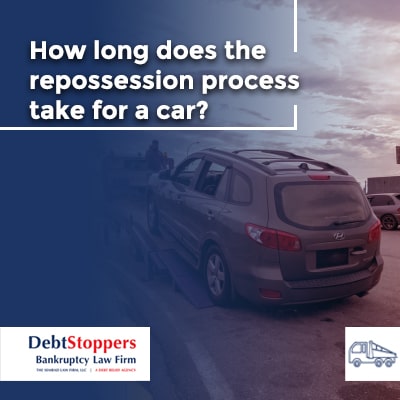
How long does the repossession process take for a car?
The repossession process can happen fast. It’s important to understand the terms of your loan agreement and the laws in your state. In some cases, a repossession can be triggered if one payment is missed, and in some states, the lender is not required to notify you that your car is going to be repossessed. However, the timing of a repossession depends on the terms of your loan and the laws in your state.
Once a repossession is initiated, a repossession agent can act very quickly. However, it’s important to understand what a repo agent can and cannot do. For example, repossession agents are not allowed to use violence or enter a locked facility to gain access to you or the vehicle.
What happens after vehicle repossession?
After the repossession agent physically takes repossession of your vehicle, you will be notified about the lender’s intent to keep or sell the vehicle. They must notify you about retrieving your personal belongings and allow you an opportunity to redeem the car by paying the full loan balance. Alternatively, if you have made a significant number of payments and have paid at least 30% of the total loan, you will have the opportunity to get back on track by paying the missed payments, late fees, and repossession costs.
If the vehicle is sold at auction, you will be notified. At auction, the lender must seek the fair market value of the vehicle, but if the sale of the vehicle doesn't cover the remaining balance of the loan, you can be held responsible to pay for a vehicle you no longer possess.
Can you stop repossession?
Yes, if you know you cannot make your monthly car payment, you can try to communicate directly with the lender. They may be willing to make a modification or allow you to defer your payments. However, if you are unable to afford your car payments in the long term, you may need to consider selling the car or voluntarily returning it. If you are not comfortable trying to negotiate directly with your lender, an attorney may be able to help negotiate on your behalf. Sometimes, lenders are willing to adjust the terms of the loan.
Additionally, if the car is worth less than the remainder of the loan, you may be able to seek a cramdown, which adjusts the loan amount to reflect the value of the car. Cramdowns can help people save thousands of dollars and ultimately make their monthly loan payments more affordable.
Even if a repossession has already been initiated, you still have options. An experienced bankruptcy or repossession lawyer can make sure you understand your options.
Pat is the Managing Partner of The Semrad Law Firm, which does business as DebtStoppers, the largest consumer law firm in the United States. Patrick concentrates on providing access to affordable legal representation to bankruptcy clients regardless of their income. Since 2004, the firm has grown from four attorneys in Chicago to over 85 attorneys in five states with offices in Europe as well.
Practicing consumer bankruptcy law is a privilege for Pat. He knows of no other area of law that empowers an attorney to make such an immediate positive impact on his clients’ lives. It has been Pat’s mission to foster a team of attorneys and staff who are as passionate about helping individuals and families that are facing financial hardship. In this, Pat views his position as Managing Partner to be a support role dedicated to providing resources and professional development to every employee at DebtStoppers.
Pat periodically volunteers legal services through the North Suburban Legal Aid Clinic and the Together for Childhood Network in Lake County. He advises The Balance Project, a local not-for-profit founded by his wife, Agi, which supports mental health throughout the community.
Pat is a member of the Illinois Bar, Florida Bar, and General Bar for the U.S. District Court for the Northern District of Illinois. Mr. Semrad graduated magna cum laude from DePaul College of Law, where he was a member of the DePaul Law Review. He also received his Bachelor’s degree in Finance from DePaul.
Outside of his professional activities, Pat is an active member of the Windy City Chapter of YPO. He is also an active community member in Highland Park and regularly participates in local events and political campaigns. He enjoys woodworking, sailing, and playing terrible paddle. He is also a member for the Union League Club of Chicago.
Education: J.D., DePaul College of Law · B.S., Finance, DePaul University, 2001