How long does chapter 7 bankruptcy stay on your credit report?
Updated on 18 September 2026
Table of content
Quick Answer: How Long Does Chapter 7 Bankruptcy Stay on Your Credit Report?
A Chapter 7 bankruptcy entry can remain on your credit report for up to 10 years from the original filing date. While your debts may be discharged in a matter of months, the bankruptcy public record, individual account tradelines, and credit scoring recovery follow separate timelines.
Before evaluating your credit report timeline, review:
Your exact bankruptcy filing date (the 10-year clock starts at filing, not at discharge)
Whether your case is Chapter 7 (10 years) or Chapter 13 (commonly 7 years under bureau policy)
The distinction between the court public record and creditor account tradelines
Whether individual included accounts reach their 7-year delinquency limit before the bankruptcy public record expires
The reporting status of discharged debts (they should reflect a $0 balance and "included in bankruptcy")
Updated 2026 credit reporting standards and dispute rules under the Fair Credit Reporting Act (FCRA)
How newest FICO scoring models evaluate credit rebuilding post-discharge
Applicable 2026 state exemption limits protecting new income and property as you rebuild
Important note: A Chapter 7 discharge legally eliminates your personal liability for eligible debts, but it does not erase the bankruptcy filing from public records. Hiding past filings, providing inaccurate dates during loan applications, or failing to report dispute errors to Experian, Equifax, and TransUnion can create serious legal and credit complications.
How Long Does Chapter 7 Bankruptcy Stay on Your Credit Report?
A Chapter 7 case may be discharged and closed years before its entry disappears from a credit report. People tend to remember when their debts were discharged, while the credit bureaus generally count from the earlier filing date.
This is more than a technical distinction: the bankruptcy record, the accounts included in the case, and the resulting credit score follow different rules and do not expire together.
The filing date usually controls the reporting period
The Fair Credit Reporting Act allows an ordinary consumer report to include a bankruptcy for up to 10 years from the order for relief or date of adjudication. In a voluntary case, filing the petition constitutes that order, so the clock ordinarily starts at filing rather than discharge or closing. The governing provisions are 15 U.S.C. § 1681c and 11 U.S.C. § 301.
If a case was filed on September 15, 2020, and discharged months later, the reporting period would generally run from September 15. Discharge resolves personal liability for eligible debts; it does not restart credit reporting.
The practical answer to when is chapter 7 removed from credit report begins with the filing date shown by Experian, Equifax, and TransUnion. Because updates may not be simultaneous, an exact removal day requires reviewing both the court record and each bureau's file.
Why Chapter 7 and Chapter 13 follow different bureau practices
The query chapter 7 stays on credit report for how long produces two seemingly conflicting figures. Ten years generally applies to Chapter 7, while the bureaus commonly remove Chapter 13 seven years after filing, a distinction reflected in guidance from TransUnion and Experian.
Chapter 13 is a wage earner's plan for eligible individuals with regular income and usually runs for three to five years. That repayment period does not control credit reporting. Federal law permits bankruptcy information to remain for up to 10 years; the earlier removal of Chapter 13 is bureau policy.
One bankruptcy case can create several report entries
The bankruptcy may appear in a public records section, while creditors list their tradelines in an account information section, often noting that a debt was included in bankruptcy. Labels vary, but the entries remain legally distinct.
Collections, charge-offs, and similar account information generally remain for about seven years from the original delinquency. Bankruptcy does not reset that date, so an account may disappear before the Chapter 7 entry, and accounts from the same case may expire at different times.
After discharge, eligible unsecured debt generally should not be shown as a balance still owed, although its history may remain. Secured debt, reaffirmed agreements, valid liens, and nondischargeable obligations require separate treatment because discharge does not eliminate every obligation. A business entity may file under Chapter 7, but only an individual debtor receives a Chapter 7 discharge.
Worried about how Chapter 7 bankruptcy will impact your credit report or ongoing collection actions?
Credit reporting is separate from the court record and automatic stay
Removal from a credit report neither erases nor seals the case. Bankruptcy filings are generally public and may remain accessible through PACER or the clerk after bureau reporting ends. The courts do not provide information to consumer reporting agencies or correct reports for consumers, as U.S. Courts confirms.
The automatic stay serves another purpose: filing normally stops or restricts many collection actions, subject to statutory exceptions and court-ordered relief. Its duration does not determine how long the case remains on a credit report.
What a credit-report dispute can and cannot accomplish
A search using how long chapter 7 on credit report may surface services promising early deletion. An accurate, timely, and verifiable entry generally cannot be removed merely because it affects borrowing. A dispute corrects faulty data; it does not erase an accurate court event.
A dispute is justified if the bankruptcy belongs to someone else, is duplicated, has the wrong date or chapter, cannot be verified, or remains too long. Incorrect account balances and statuses can also be challenged. A clerical mistake may require correction without requiring deletion of the bankruptcy itself.
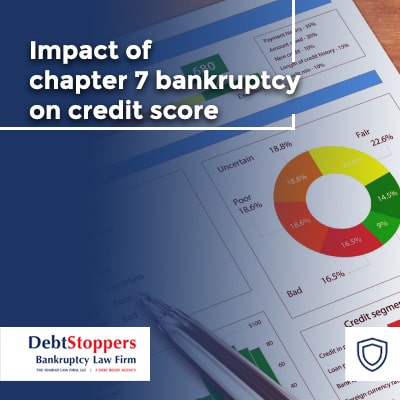
Impact of chapter 7 bankruptcy on credit score
Bankruptcy is a serious negative event, yet no fixed point loss applies to every case. Scoring models assess the whole file, including the starting score, missed payments, balances, credit utilization, recent applications, and other adverse information.
A filer with good credit and few prior delinquencies may see a different change from someone whose score already reflects high balances and late payments. The included accounts also matter, which makes the frequently repeated estimate of 100 to 200 points unreliable as an individual prediction.
The ten-year period does not mean ten years of equal scoring harm. Negative impact may lessen as the bankruptcy ages and newer positive information develops. myFICO likewise emphasizes the complete credit profile. The age of the bankruptcy alone cannot predict a recovery date, score, interest rate, or loan approval.
Rebuilding credit after discharge: what is actually useful
Examine the reports before applying for new credit. Discharged accounts should carry accurate balances and statuses, while unfamiliar entries deserve investigation. Keeping continuing bills affordable and making timely payments can establish positive payment history, although improvement is neither immediate nor guaranteed.
Secured cards, credit builder loans, and authorized-user accounts
A secured credit card generally requires a refundable cash deposit that often determines the limit. Check the fees and confirm reporting to the nationwide bureaus. Paying the statement in full can avoid interest; carrying a balance is unnecessary.
Many credit builder loans hold the proceeds while the borrower makes monthly payments. They may create payment history, but fees, affordability, and reporting matter. A payment that competes with essential expenses is unlikely to strengthen the household's finances.
Authorized-user status may help if the primary cardholder manages the account well and the issuer reports the activity. It offers no guarantee, while high utilization or delinquency may cause harm.
Credit utilization needs context
Credit utilization compares reported revolving balances with available limits. A $50 balance against a $500 limit equals 10%. Keeping utilization below 10% is a conservative target, not a legal threshold, official requirement, or promise of improvement.
New credit is best used sparingly and for a clear purpose. Someone still facing overwhelming debt should not borrow solely to influence a score. A workable budget, low balances, timely payments, and some emergency cash provide a stronger foundation.
Where can you get legal and financial advice?
A bankruptcy attorney can assess how federal law, state exemptions, assets, income, secured property, prior filings, and the nature of the debts affect a case. That analysis must account for the person's documents and circumstances, which a general article cannot do.
A reputable nonprofit credit counseling agency may help with budgeting and debt-management options, but cannot provide legal advice. Required pre-filing counseling should come from a provider approved for the district by the U.S. Trustee Program.
The Consumer Financial Protection Bureau and Federal Trade Commission explain reporting rights, disputes, identity theft, and credit-repair claims. Experian, Equifax, and TransUnion maintain their files and investigate bureau disputes. These organizations do not select a bankruptcy chapter for the consumer.
DebtStoppers offers consumers in Illinois, Georgia, and Texas a free, no-obligation attorney consultation. We can review the debt and explain applicable legal options without promising a discharge, score, or future credit approval.
Ten years on the report does not mean ten years without progress
Chapter 7 can remain visible long after the court proceeding ends, yet reporting is only one part of the consumer's position. Accurate files, affordable obligations, and consistent payments can matter well before removal.
If reporting conflicts with the court outcome or debt remains unmanageable, a DebtStoppers attorney can examine the facts and explain the available options.
Ready to clear your debts and rebuild your credit report on a realistic timeline?
Does Chapter 7 come off a credit report after seven or ten years?
The Chapter 7 entry may generally remain for up to 10 years from filing. Seven years more often refers to Chapter 13 bureau policy or separate negative accounts. The type of entry and its starting date resolve most of the apparent conflict.
Why is Chapter 7 still showing after ten years?
Begin with the filing date rather than discharge or closing, then compare all three reports. If the applicable period has expired or the date is inaccurate, dispute the item with each bureau displaying it and include relevant bankruptcy court documentation.
Does a dismissed Chapter 7 still appear on a credit report?
It can. Dismissal ends the proceeding without a Chapter 7 discharge, but does not undo the filing. A correctly reported dismissed case may remain on the report subject to the applicable limit, and the entry should reflect dismissal rather than discharge.
Do the included accounts disappear with the bankruptcy entry?
Not necessarily. Creditor accounts and the bankruptcy record have different starting dates. A delinquent account may reach its own reporting limit first, and inclusion in the case should not create a later original delinquency date or extend expired account history.
Is bankruptcy still public after it leaves a credit report?
Generally, yes. Credit-report removal does not seal or destroy the federal court file. Subject to privacy rules and any court order, records may remain available from the bankruptcy clerk or through PACER for years after ordinary consumer credit reporting ends.
Sources:
Fair Credit Reporting Act, 15 U.S.C. § 1681c
Voluntary bankruptcy cases, 11 U.S.C. § 301
Consumer Financial Protection Bureau: How long bankruptcy appears on credit reports
Consumer Financial Protection Bureau: How to dispute a credit-report error
U.S. Courts: Chapter 7 Bankruptcy Basics
U.S. Courts: Chapter 13 Bankruptcy Basics
U.S. Courts: Discharge in Bankruptcy
U.S. Courts: Bankruptcy Case Records and Credit Reporting
U.S. Trustee Program: Credit Counseling and Debtor Education
Federal Trade Commission: Disputing Errors on Your Credit Reports
Pat is the Managing Partner of The Semrad Law Firm, which does business as DebtStoppers, the largest consumer law firm in the United States. Patrick concentrates on providing access to affordable legal representation to bankruptcy clients regardless of their income. Since 2004, the firm has grown from four attorneys in Chicago to over 85 attorneys in five states with offices in Europe as well.
Practicing consumer bankruptcy law is a privilege for Pat. He knows of no other area of law that empowers an attorney to make such an immediate positive impact on his clients’ lives. It has been Pat’s mission to foster a team of attorneys and staff who are as passionate about helping individuals and families that are facing financial hardship. In this, Pat views his position as Managing Partner to be a support role dedicated to providing resources and professional development to every employee at DebtStoppers.
Pat periodically volunteers legal services through the North Suburban Legal Aid Clinic and the Together for Childhood Network in Lake County. He advises The Balance Project, a local not-for-profit founded by his wife, Agi, which supports mental health throughout the community.
Pat is a member of the Illinois Bar, Florida Bar, and General Bar for the U.S. District Court for the Northern District of Illinois. Mr. Semrad graduated magna cum laude from DePaul College of Law, where he was a member of the DePaul Law Review. He also received his Bachelor’s degree in Finance from DePaul.
Outside of his professional activities, Pat is an active member of the Windy City Chapter of YPO. He is also an active community member in Highland Park and regularly participates in local events and political campaigns. He enjoys woodworking, sailing, and playing terrible paddle. He is also a member for the Union League Club of Chicago.
Education: J.D., DePaul College of Law · B.S., Finance, DePaul University, 2001